
Among the gems of the eleventh edition of Seeyousound Festival is Going Underground, documentario diretto da Lisa Bosi which tells the long story of Gaznevada. A film in competition in the Long Play Doc section that managed to sell out both of its scheduled screenings. The second takes place tonight, Thursday 27 February, and after the screening Ciro Pagano (aka Robert Squibb) and Marco Bongiovanni (aka Chainsaw Sally) of Gaznevada will take the stage for an unmissable evening at Capodoglio. There they will perform, two years after their return to the scene following their break-up in 1988, in an exclusive live/DJ set that has travelled as far as Berghain in Berlin, together with Johnson Righeira, Straker Commander and I-Robots (aka Gianluca Pandullo), in the spirit of their new wave and Italo disco hits.
But back to the film. A look at the history of this Bolognese band amid heroin, squats, free radio stations and the comics of Andrea Pazienza. The success with the public shows how much interest there was behind this wholly Italian punk slice of life. One of the documentary’s strengths is that Gaznevada tell their own story without reservation or shame. And without judgement, except towards themselves and the rather tough environment they frequented. Gaznevada, whose original line-up was made up of Alessandro Raffini (Billy Blade), Ciro Pagano (Robert Squibb), Giorgio Lavagna (Andy Nevada), Marco Dondini (Bat Matic), Gianpietro Huber (Johnny Tramonta) and Gianluca Galliani (Nico Gamma), formed in a particular historical climate, managing to capture the very 1980s aspects of nihilism and self-destruction, passing through success. Not without consequences, of course.
Just before the second screening scheduled at Seeyousound, we managed to ask Ciro Pagano/Robert Squibb and Lisa Bosi a few questions about the band and the film.
Did you feel an urgency to open up and tell the story of Gaznevada, which began forty years ago now?
Ciro Pagano: In truth, personally, I had declined the invitation to tell our story several times. Ours is a “rough” story too, and like all stories it depends a great deal on the point of view from which you look at it. The narration is fundamental to understanding it, and Lisa approached us with the right attitude, the visionary one. So, while she became passionate about telling the story of Gaznevada, we became passionate about her telling of it.
Was it difficult to address the subject of substance use?
Ciro Pagano: The use of substances is an integral part of the whole story of Going Underground and of Gaznevada. Musical culture – and not only that – has always gone hand in hand with drug use: from jazz to psychedelia, from rock to punk. We used them heavily, but it wasn’t our priority. It may sound strange, but the “focus” at the Traum Fabrik was creative urgency: drawing, writing, reading, painting, photographing, writing screenplays, listening to and producing music. Our model was Warhol’s Factory, and I still like to think that we were like the Velvet Underground.
Speaking of music, why did you prefer the punk of the Ramones, so American, to other bands of English origin? And did you perceive the musical evolution, or desire for change, that led to dance and the birth of Datura?
Ciro Pagano: When Giorgio (Andy Nevada) brought the first Ramones record to via Clavature (the Traum Fabrik), it was a real shock. I remember the compact wall of sound of their songs, lightning-fast tracks that started again with the same energy, track after track, for the whole length of the album. Until then, the progressive rock of Yes, Genesis, King Crimson – to name a few – expressed itself through long suites. The Ramones suddenly made the entire musical landscape look old. We were ready to follow them. Personally, I never found the same energy even in the Sex Pistols… a matter of taste? Gaznevada were restless kids, who quickly tired of what they were doing. For us, punk began in November ’77 and was already over by ’79 with the single Nevada Gaz. With Sick Soundtrack (1980), we were already elsewhere. I have always shunned music when it was codified into a genre. At the end of the ’80s, when I heard French Kiss by Lil’ Louis, I understood that a new musical revolution was coming, even stronger than punk. At the end of the ’70s, punk had given a voice to those who were not virtuosos of their instrument: three chords were enough. Between the end of the ’80s and the beginning of the ’90s, house allowed non-musicians – the DJs – to express themselves: a sampler was enough. I traded my amplifier and distortion pedal for a sampler and a computer, and a new path began with Stefano Mazzavillani. Shortly afterwards, in 1991, Datura were born. It had to be done.
Going Underground is a very Bolognese story. What was Bologna like in those years? Do you find differences with the Bologna of today?
Ciro Pagano: Going Underground is a story set in Bologna, but I believe it is a story about Italy in those years. As for the city, I’m no longer a great frequenter of it. I think not much is left of those years apart from the guided tours for the tourists who crowd the historic centre. Incidentally, I know there is a guided tour about us too, the Traum Fabrik and dear Andrea Pazienza. The Times They Are A-Changin’
The first screening at Seeyousound sold out. Did you expect it? How did it feel to see the room full of enthusiasts?
Lisa Bosi: The first screening at the festival was very emotional. I didn’t expect such a success with the public, but I was hoping for it. It also shows the full communicative power of a festival like Seeyousound. Over the years it has become a true point of reference for cinema dealing with musical themes. Every year the selection offers absolutely unmissable titles, and so we were particularly happy to have been selected as the only Italian title in the international competition. Cities like Turin and Bologna respond well and warmly embrace film festivals as wonderful as this.
Ciro Pagano: I was told about it and I am very happy, especially for Lisa, who really did an excellent job.
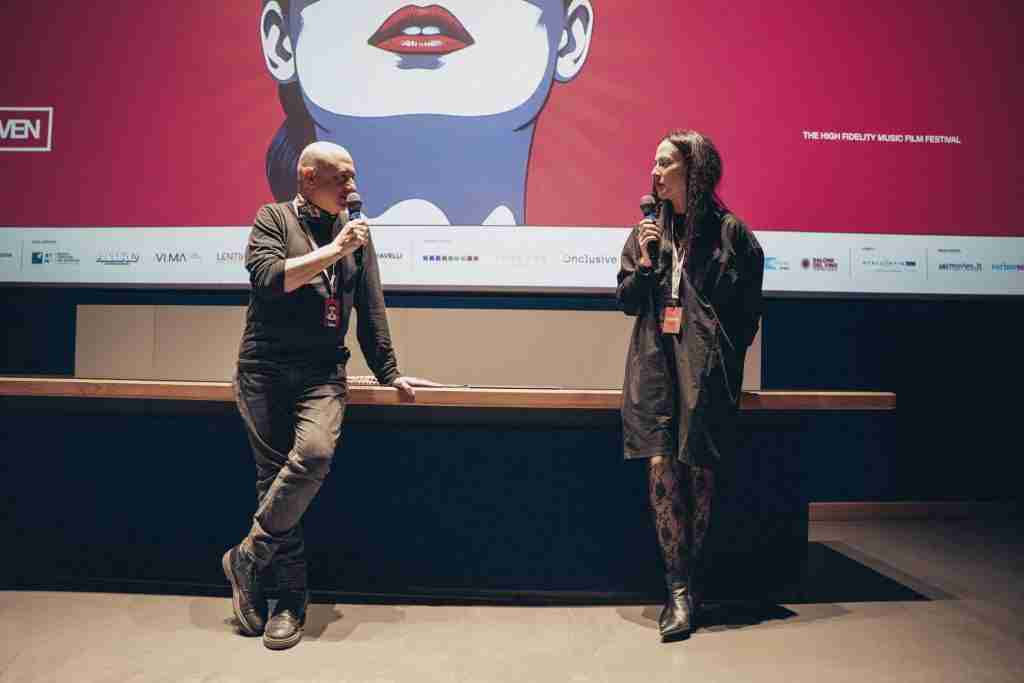 Paolo Campana, Long Play Doc curator, and director Lisa Bosi present the first screening of Going Underground at Seeyousound. Photo by Elisabetta Ghignone.
Is the documentary, like last year’s Synth Soundtrack project, a point of restart for a reunion, or did you just want to tell your story? Is there anything else in the works for the future?
Ciro Pagano: The idea of Going Underground came about after Lisa came to see one of our performances, mine and Marco’s (the bassist with whom I carried on the Gaznevada adventure). We were at the DAMS in Bologna, where before the show there was a talk scheduled on the end of the 1970s in Bologna: the student struggles, the squats and Gaznevada. Marco and I had already started taking an interest in the Gaznevada project again with the Synth Soundtrack operation carried out with Giorgio Lavagna (Andy Nevada). After the DAMS we were called by Berghain in Berlin, and soon after we performed at several clubs and festivals. Meanwhile the work on Going Underground had begun and Lisa asked us to write three new tracks specifically for the docu-film. In the meantime we reworked “Mamma dammi La benza”: it seemed right to pick up from where we had started, and now Gaznevada is once again an active project. We just want to produce new music and start performing live again.
Can you tell us a funny anecdote that happened during the making of the film?
Lisa Bosi: I started on the first day of shooting with the hardest scenes, the ones on the badlands. It was many hours on glacial, lunar terrain. It was January. I directed the drone shots from base camp and over the radios I heard their “complaints”. They were freezing, but they were brilliant! No stunt doubles were used! Super professional!


